
Please Click to Join my Email List and Get a Great Offer on a Fantastic Book!
What Is Responsible Gun Ownership?
I have chosen to do both a blog post as well as a video (coming soon) on this subject of gun storage at home. There are a few similarities from my video on Vehicle Firearm Security that you can watch here. https://www.youtube.com/watch?v=vLAcsL6QQ-8&t=12s. The devices I showed in the video can be useful at home as well, but one of the greatest concerns of storing firearms in the home is even more important than theft prevention. It is the safety of children and those who may be a danger to themselves and others.
While I have no qualms about saying that any gun law is an infringement on our 2nd Amendment right to keep and bear arms, we as a society often forget that for every right which we are entrusted, there is also an implied responsibility. As it applies to firearms, I believe that responsibility is to not only be constantly mindful of the safe rules of firearm handling, but to also be responsible for the security of firearms not in hand or on our person.
One of the greatest enemies the gun owning public has is our own complacency!
Yes, you read that correctly. Just as i pointed out in my video on firearm security in the vehicle, stolen guns are the vast majority of the guns used in crimes. More importantly than that, the number of accidental shootings caused by unsecured firearms being found by children is painful to read. I personally know someone who lost a young family member to an accidental shooting. Family stopped by for a surprise visit and he hadn’t put his pistol up simply because it was just he and his wife there all week. No more honest a mistake ever led to a more horrible tragedy. I encourage everyone to make sure your firearms are either on your person and under your control or in some way secure to make sure that no one else has to go through this heart breaking tragedy.
The danger extends beyond that of children. Many suicides and homicides happen each year because someone who was psychologically unable to control the urges they felt had access to a firearm. While mental illness is a struggle that goes untreated or diagnosed in many people, some of the “mass shooters,” as the media calls them, have had long histories of documented mental health issues and in many cases, they simply used a firearm that was unsecured in their home to commit horrible acts. I can’t sit here and say that they wouldn’t have found another way to commit these acts, however there is no way I would want to wear the guilt of knowing my lack of responsibility made it that much easier for a person to injure themselves or others with a weapon I owned.
This post is a reminder to me as well. I have had lapses of responsibility that could have had horrendous consequences. By fortune or God’s grace, i was able to correct that failure before anyone got injured, but i still shudder to think about it.
Home Firearm Storage Options
I’m going to list some options in order of cost and mention the pros and cons of each as we go down the list. Check out my YouTube video below to see examples of some of the simplest and cheapest way to keep your home safe.
Gun Locks and Trigger Locks
If i remember correctly, the last gun i purchased and several prior to that, I was asked if I needed a gun lock and had to sign that I had been offered one. I always refuse because I have a safe, as well as a file cabinet full of those locks when they were supplied automatically by many manufacturers, however they do serve the purpose of disabling a gun from being used while the device is attached. Some versions lock through the trigger guard blocking access to the trigger. Other types are simply a pad lock with a flexible shank that is threaded through the action of the gun to keep the bolt from closing, preventing the gun from firing.
These locks are not much of a theft deterrent unless they are attached to an anchor point or cable, and then a determined adult can probably destroy the lock in fairly short order with some basic tools. The application that these locks do serve well is to keep guns from being accidentally fired by children or others who find it. I will place a link below, but you can contact any firearm manufacturer and they will provide one for you, usually free of charge. There is no excuse not to have at least this level of security against accidental shootings!
Snapsafe Cable Padlock


Lock Boxes
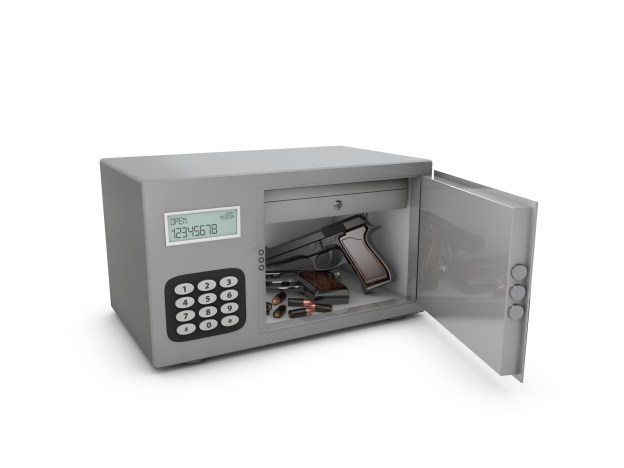
With multiple options available, you can surely find one for your needs and budget, but I will just list two types of lock boxes here. The very basic version, and a much more convenient but more costly version as well. These are a step up in security for your guns since they not only keep the gun from being used, they also may take significantly more effort to get the gun out and accessible. The limiting factor of these boxes is the fact that they can be easily moved if there isn’t a solid way to anchor or attach them and solid anchor points in the home are usually limited. Here are two types that I have personally had experience with and recommend:
Snapsafe Lockable Gun Box with Security Cables


GunVault Biometric Pistol Safe


Gun Cabinets
For the sake of this post, I will mention that gun cabinets come in more than one type and the level of security is very different in each. The decorative wooden gun cabinets often seen in the dens and man-caves of homes are usually far from theft proof, however with a locking door, they are, at least, a means of keeping young hands off the guns. The type of gun cabinet I consider a step up from locks and lock boxes is the metal locking style of gun cabinet that resembles a gun safe, but usually lacks the fire resistance and often has a simple keyed lock in lieu of a combination or keypad. The security factor of these cabinets is much higher because of the size as well as the ability to anchor them to the walls and floors in your home or other location. This option should prevent any accidental handling and make it a more time consuming job to break into the cabinet since it must be done on location. One concern is the keyed locks. Make sure that you keep the key on you or in a secure location. If a curious youngster finds a key on a nightstand, and later finds a cabinet in a basement, it won’t be long before they are seeing if it fits. Here is an example of a quality gun cabinet:
Stack-On 18 Gun Security Cabinet


Gun Safes
The highest level of homeowner gun security likely lies in the purchase of a fire resistant gun safe. These have a few factors that add security to them. First is they weight. The fire resistant feature of safes is made possible by layers of gypsum board, or sheet rock in the walls of the safe. I have seen several arguments as to how well the fire proofing works and I haven’t seen proof from either side to feel I have an argument to make, however, I do know that those layers of sheet rock add to the overall weight and make moving one of these safes much harder than a lighter cabinet. Another security factor is the locking system. Quality costs money, so you can expect cheaper safes to have less secure locking systems, but the more expensive ones will often have very good locking systems as well as a re-locker mechanism that is spring loaded and locks the safe where only a person with proper training and the aid of a drill and template can open it if someone tries to destroy the lock to gain access. Often the purchase of a safe is more cost effective to do locally, but I will list an option below if you are looking for a quality safe that can be shipped to you.
Snapsafe Titan Modular Gun Safe


Final Thoughts on Firearms Security
As gun owners, we are facing more hostility every day from many angle. The political and media landscape has no concern for the root causes of violence and simply blames the tool used. It is our duty as armed Americans to make sure that we make every effort to make sure our firearm are only used in safe and proper ways and to make sure we don’t leave ourselves and others open to tragedy through our negligence.
Disclosure: I am an Amazon affiliate and make money on qualifying purchases.




 Nick's Preparedness