Category Archives: Prepper Skills

Everyday Situational Awareness

Please Click to Join my Email List and Get a Great Offer on a Fantastic Book:

What is Situational Awareness

By simply defining the two terms, we can pretty much assume that situational awareness is simply being aware of your current situation. That is a correct observation, but only scratches the surface of what being aware of our surroundings really is and why it is of the utmost importance for our safety and well being. As creatures, we have evolved into a race of smartphone focused zombies in many ways. We often see videos of people walking down the street, looking at their phones, that walk into traffic or telephone poles. I would be willing to wager that ninety-nine plus percent of us have texted while driving or been otherwise preoccupied with something besides what we are doing. Even gathering in a group where there is a main focus, such as a concert or rally of some sort; takes our awareness of things around us. The things we don’t see can sometimes be a big problem. How many people would knowingly walk into the scene of a mass shooting just before it happens? Would anyone willingly stroll down the street knowing that they will get mugged or assaulted? How about wondering into a large group of people that you know is about to become a violent riot? The use of situational awareness can and does prevent us from from potential harm on a daily basis even if we don’t realize when we use it.

Is Situational Awareness Being Paranoid?

To be aware enough of your situation to avoid harm might seem a bit paranoid. Constantly looking all over the place for the least sign of a problem. Trying to have eyes in the back of your head. It sounds like a huge burden on the outset. That is, however, not the case. Like any undertaking, we must first be consciously alert to the skills and habits we need to develop. We have to almost exaggerate them and be somewhat focused on the new habit, but soon it will become second nature. Situational awareness in no way makes us omnipotent or able to literally have 360 degree vision. It also doesn’t have to consume us. With a little bit of effort, it becomes almost a subconscious radar for bad situations then alerts our conscious attention to whatever the cue is.

Developing Situational Awareness

There is no shortage of techniques available to sharpen your situational awareness, but many simple “games” can help you out tremendously. Make it a habit to know before someone is within 5 feet of you. To do this you have to be somewhat alert, but not necessarily scanning in a circle. Knowing where the entrances and exits of a room are can give you a lot less area to have to focus on. Glancing at mirrored surfaces, such as windows, glass matted pictures, and polished objects that we find all around us, are ways to be aware if you are being approached. Choosing a seat that gives you a view of the paths of ingress and egress are key to reducing the odds of being caught off guard. While this is very basic overview, I hope it gets everyone thinking about how close someone can be to them before they realize it.

Now that we are looking around we need to know what to look for. People constantly give off cues within their body language, tone of voice, and general demeanor. If you look back at my post about the “Gray Man”, you will find that these cues are often the opposite of someone who blends in. You can read that post here: https://nickspreparedness.com/2020/07/26/how-do-i-blend-in-with-the-crowd/

Taking notice of someone who looks or acts out of place in a situation should be a normal task that our minds alert us to. This does not mean to make assumptions about the person or group of people, however you simply become aware of their presence and that something doesn’t fit. The vast majority of the time, there will be a perfectly good explanation for the cue we notice and nothing to worry about, however, if they begin to act in a concerning or threatening manner, we won’t be caught off guard or have let them into our personal space without noticing.

Sometimes awareness is simply making a habit of paying attention to a few things that we might normally overlook. Did we glance in the back seat of the car before getting in it after being in the store? Have we glanced in our mirrors regularly while driving to notice if we are being followed home? Are there groups of people where there normally aren’t many folks congregated? Do we notice a large police or military presence all of the sudden? Any of these checks or cues can alert us to raise our level of vigilance from normal to alert and, in many cases, help us steer clear of potential problems.

For a short, practical, and almost brutally straightforward explanation of awareness and personal defense in general, I cannot think of a better book to recommend to anyone than Col. Jeff Cooper’s “Principles of Personal Defense”. You can find it here:

You won’t find a better baseline for personal defense and awareness than this book and the suggested books you find in the link can build on the basics Col. Cooper lays out. Things can turn bad quickly. Are you going to notice in time?

Watch my video about situational awareness in the car:

Disclosure: I am an Amazon affiliate and make money on qualifying purchases.
What Type of Survival Shelter Should I Build?

Please Click to Join my Email List and Get a Great Offer on a Fantastic Book:

From the earliest history of mankind, our ancestors sought out shelter. Shelter, combined with fire and clothing have made the human race able to withstand climates from the equator to the arctic and almost everywhere in between. It should go without saying that we rely on shelter as much, if not more than ever and it can easily be the key to our survival. We should always have some plan for shelter that is feasible for our conditions an needs. Shelter is one of they keys to preparedness as I mentioned here in my post on how to get started prepping. You can visit it here: https://nickspreparedness.com/2020/07/14/how-to-start-prepping/

Different Types of Survival Shelters

The list of shelters can go much farther than we should concern ourselves for temporary use, but learning more about they styles and purposes and how they are erected can be very helpful should we need to improvise. Take a look at this book on the subject:

The Complete Survival Shelters Handbook

For the purpose of this post, I’ll divide the shelters into two types, the pre-made shelter and the improvised shelter.

The Pre-Made Shelter

I’m not happy with the term and would like to think of a more descriptive word for this type shelter which is usually some sort of store -bought tent or emergency shelter. Tents have the advantage of being made specifically for outdoor use and designed for multiple assembly and disassembly routines. Most pack down to a fairly small size and the tents designed for ultralight backpacking weigh almost nothing. I kept an older version of this tent with my go bag and have used it multiple times for camping trips with great results. They aren’t cheap but you pay for quality and light weight:

Big Agnes Copper Spur Tent:

Another option for the go bag is some sort of emergency tent. In a short term survival situation being out of the elements to a reasonable degree is much more important than having a shelter you can reuse for years. It is nice to have a quality tent, but a cheaper and more disposable option is one like this:

Life Tent Emergency Survival Shelter

The Improvised Shelter

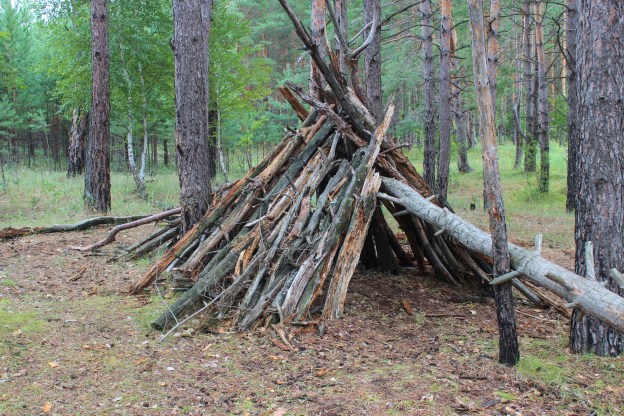
The improvised shelter is usually much more rustic and might take some ingenuity to prepare, but it has some important advantages. Tents are designed to sit on level footprints. Improvised shelters may be fitted into the terrain to better camouflage the user or to use the natural landscape to our advantage. Improvised shelters are also made, partly, of the supplies we carry with us in our bug out bags for multiple purposes which means we aren’t adding additional weight to our packs for the sake of comfort that might not even be a practical option.

What Do I Need To Make a Shelter?

Your choice of shelter will necessitate the materials you need, but there are some things that are much harder to manufacture than they are to just carry. Some forethought into our most likely scenarios will yield plenty of ideas on what we can scavenge for shelter materials and what we would be much better off to carry along with us.

Water Shedding Material.

While it is true that most areas with significant rainfall also generally have plenty of plant life that can be used to build a shelter with water shedding properties. Large leaves layered like shingles, thick evergreen boughs layered in a similar fashion, as well as sod and moss can provide a dry roof to stay under, but none of these are quickly erected and quickly removed if you need to cover your tracks. A great item to use for a field expedient, rainproof covering is a tarpaulin. They are available in various sizes and pack down with minimal space. Here is an example of one that i would consider for a vehicle or bug out bag:

Camouflage Water Proof Tarp

Cordage

Cordage is one of the things that you can carry far more efficiently than you can manufacture. Lashing sticks and limbs together to support a covering with vines or woven fibers from grasses or bark is an art and can be very secure, however we aren’t planning on establishing a new settlement and traditional design and architecture plays a distant second fiddle to getting out of the elements in a hurry. One of the best types of cordage to have on hand is Parachute Cord, or paracord for short. It packs down to a small size and you can carry hundreds of feet with very little space and almost no noticeable weight or bulk. Para cord can be used as a tarp support, to lash limbs together or to tie off the base of a tarp to anchor points or stakes. It’s one of the most versatile products in the prepper’s toolbox and has uses far beyond just shelter. Pick some up for your own Vehicle and Go Bags here:

550 Paracord for Everyday and Survival Use

If you want to see just what all you can do with some paracord, take a look at this book i found, or some of the others like it!

Outdoor Paracord, by Todd Mikkelsen

Tape

The reputation of duct tape as being a repair on a roll is often brought up when things go wrong. It is usually the first sarcastic suggestion for any major breakdown or accident, but, like most stereotypes, there is a lot of truth behind the joke. Duct tapes are strong and durable and will stick in conditions where other adhesives wont dare attach themselves. It is a staple in field medical kits because it will stick to skin that may be soaked in blood or sweat much more readily than most medical tapes. With all of that ability, it stands to reason that its more than ready to help us secure the ends of a poncho or scavenged piece of plastic to some poles or tree trunk to make a shelter. I usually have several rolls available in my bag and vehicle. Remember one thing though, there are several qualities of duct tape. This is the brand i have used the most and recommend:

Gorilla Black Duct Tape:

Final Thoughts on Survival Shelters

Like almost any other skill, assembling a shelter takes practice. what we imagine, or even see work for others may not work at all when we try it. This even applies to tents and other manufactured shelters. I plan on trying as many versions as I can in the future and doing reviews and tips on them as I can. In the meantime, if you have any tips or advice to offer, please leave a comment.

Disclosure: I am an Amazon affiliate and make money on qualifying purchases.