

Sometimes we find ourselves in need of something specific to our situation that no ready made source seems to offer. Other times we need to repair something that is inconvenient or impossible to move. Often times we simply enjoy the satisfaction of building something for ourselves. Learning how to make basic welds on metal is a great way to reach many of these goals, and often with less expense than purchasing or hiring the work out to be done. There are initial costs when purchasing a welder and there are consumables such as rods, wire, and gasses, but it usually doesn’t take but a few projects to absorb all of that cost and leave you ahead of the game financially
What Is Welding?
In its most basic form, welding is heating two pieces of metal, often with a filler material included, to a temperature where all of the two or three melt and bond into one fused metal. This task was originally done by blacksmiths who heated metals in a forge and would get them to a near liquid state and beat them together on an anvil to fuse them. Those who watch some of the reality shows such as Forged In Fire will see a form of welding done when the blacksmiths forge and hammer wire into solid steel to for a Damascus metal blade. Modern welding is more often done with either an oxy/acetylene torch or with electricity to melt the metals together. When welded properly, the weld seam is even stronger than the metals that it joins which leaves no doubt as to why its handy for building and repairs.
Why Do Preppers Need To Learn To Weld?
There is almost no end to the skill sets that we could benefit from as preparedness minded individuals and by no means do any of us have time to learn, much less master, all of them. If at all possible, we should seek out a network of like minded individuals with which to barter both supplies and skills. Just as one nurse can benefit a large number of people in a group, so can one skilled welder, mechanic, gunsmith, carpenter, butcher, etc. Now that we have covered that no everyone is going to be a welder, we can get into the importance of having at least one in our midst as a prepper group.
Repairs: Based on the situations we find ourselves in, we may not be able to get to a repair facility. Our implement that is broken may not be easily transported. Shops may be closed or unavailable due to disaster or unrest. We may also have projects that we don’t necessarily want anyone to know about besides our group. Consider a steel vault opening or a set of metal stairs leading into a bunker we have dug into the ground. If I took the time to plan and build such a place, I would be very concerned about my operational security (OPSEC) when it comes to having work done on the site. You may have a vehicle that you have modified for special defense or security purposes and you don’t want it sitting in a repair shop drawing suspicion. For less secretive purposes, having some type of welder, especially a portable one will allow us to repair gardening and homesteading equipment whenever and wherever we need to. A broken trailer axle or tongue three miles up a logging road, full of fire wood is no place to be without a way to make a repair. If you want to read more about OPSEC, check out my post on going undetected Here.
Fabrication: The world is now full of products that fit our needs as preppers and survivalists. I try my best to review and post the ones that I believe we can benefit from both here and on my YouTube channel, however not all of them fit our exact needs and, again, good OPSEC may dictate that we chose not to order or purchase some items on the market. I began working with and around welders and torches in high school while working for a trucking company. After starting college I went to work for a wrecker service that built equipment which offered me an opportunity to do more fabrication work. Creating a usable piece of equipment out of nothing more than tubing, angle iron, and flat steel is an incredible feeling and it is not as hard as you would think. Often times it is possible to repurpose and salvage unused metal on hand to build something new and useful to us. In the future, I’ll try to add some posts and videos of projects as I do them, but for now, just consider anything that you see made out of metal, especially steel to be something you can use, repair, or replace with welding skills.
What Types Of Welding Should We Learn As Preppers?
I am going to limit this post to just a few types of welding that are pretty easy to become proficient enough in to handle around the house or farm type repairs and projects. There are many more and they produce amazing results, however, the equipment cost and techniques needed are more reserved for the career welders. If you have one in your group, they can produce amazing work. If you want to learn on your own, click on the picture for a welding manual.


Oxy/Acetylene Welding: Next to the ovens in the blacksmith’s forge, this is likely one of the most elementary welding methods, based on equipment. Using a torch fueled by a mixture of oxygen and acetylene or propane, the flame is focused on a narrow point on the metals and as they melt, a filler rod is added to the joint. One note to add to this is that almost all welding methods produce or render out impurities in the metal. The addition of some sort of flux or shielding gas is needed to remove the impurities and is often a coating on the filler material rod. For lower stress joints and sealing up certain types of metal fittings, lower heat options such as soldering or brazing also make use of a torch.
An added benefit of having a welding torch is that the system usually includes a cutting attachment which is a very handy tool to cut metal with. You can get a handy portable torch set by clicking the picture below.


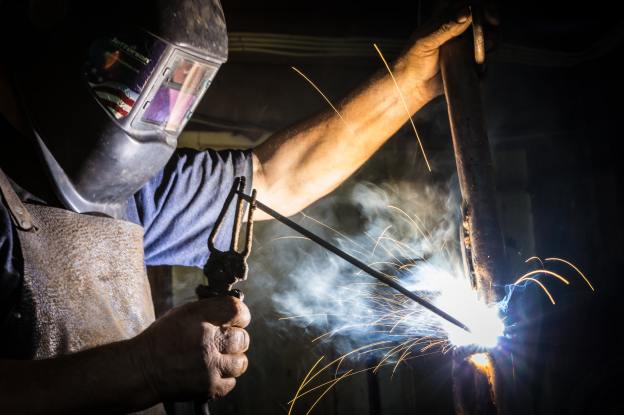
Stick Welding: Shielded metal arc welding (SMAW) is informally known as “stick welding” due to the electrodes that are used. The electrode, or rod, is a metal rod about 12 inches long that has a diameter ranging from 1/16 of an inch to 3/16 of an inch or larger which is covered in a hard coating that melts off and helps remove impurities in the weld as it burns. Because of the variety of rod types and sizes available, and the portability of some of the machines, stick welding is one of the best choices for use on the farm and around the home. Depending on the amperage your welding machine is capable of, it’s possible to weld up to 3/8 of an inch thick steel or more with a machine that can be powered by single phase current found in homes. While preparing the welding surface is crucial to getting the best results, several rod varieties are also known to perform well in less than ideal environments such as rusty or dirty metals. Other methods don’t readily offer this luxury. One of the staples found in many workshops, garages, and barns is the reliable Lincoln Electric “Buzz Box.” You can check it out by clicking the picture below.


Flux Cored Wire Welding: Bridging the gap from stick to solid wire welding is flux cored wire. The machine is used like the GMAW welding I will discuss in the next paragraph, however it requires no shielding gas. It does, however leave a coating of slag that must be chipped away like stick welds produce. The convenience and ease of use make these handy for a home workshop since some of them can be run on common 120v A/C power circuits in a home. Click on the picture below to take a closer look.


Wire Welding: Gas Metal Arc Welding (GMAW) or Metal Inert Gas welding (MIG) is the process of welding with a roll of wire that is fed through the lead. This wire acts as the electrode and filler metal, just like the rod does in stick welding. The difference in this wire is that there is no flux present. The impurities are shielded from forming by the use of compressed gas. Usually a mix of argon and carbon dioxide is used for mild steel welding. This method when paired with properly cleaned and prepped material is one of the fastest and smoothest welds to perform and with a little practice a novice welder can make strong and attractive welds. The few downsides of wire welding both involve the gasses needed to shield the weld. If you run out of gas, you are done welding, so you must have a supply on hand or be able to get more from a welding gas supplier. When using the welder, you must be shielded from wind or fans blowing across the surface or the the shielding gas will not serve its function and the weld will be extremely poor in quality and appearance. For a quality M.I.G. welder, click below on the picture.


Welding Accessories
I will start this section assuming that the welder any of us purchase has the leads and shielding gas tanks with it and they are ready to use.
Protective Gear: Since welding creates substantial heat and is damaging to the eyes, we need some basic protective gear to be safe. Below is a basic welding hood and some gloves to get started with.


Rods/Electrodes/Wire: Depending on the machine we chose and the material we are welding, we may need any of a variety of these accessories. remember they are all burned into the weld as filler material so they are consumed at a steady pace.
Grinders/Sanders: Cleaning metal can be done with a wire brush and file if needed, but a much more expedient method is the use of an electric grinder. Most grinders will have the attachments necessary to use a variety of wheels, from a grinding stone to a wire brush or sanding pad. having an assortment of these on hand will help you prep and clean up a job in a hurry. Click on the picture below for a great grinder for all the purposes.


Consumables: Depending on the style of welder you chose, you will likely have some more parts that have to be replaced regularly, especially when you are learning to weld. Nozzles, welding tips, and other small parts that are easily affected by being close to the heat of the weld should be kept on hand in case they are needed.
Welding Safety Concerns
There are multiple health and safety concerns when welding is involved, no matter what method is used.
Heat: To make a weld, we are using either electricity or concentrated flame to heat metal into its liquid state. Not only are we susceptible to severe burns when touching the welded metals, there are also sparks and weld splatter that flies off in all directions. The best way to combat these issues is to wear heavy welding gloves and 100% cotton shirts and pants with the sleeves tucked in the gloves, but the cuff of the pants outside the top of the boots.
Fire: Directly related to the heat mentioned above is the fire hazard. Anything that is remotely flammable will ignite after getting molten metal sparks dropped on it repeatedly. Whenever possible, it’s recommended to have a “fire watch” or person who’s job it is to watch the welder and area to make sure nothing catches on fire and to stope the welder and put it out quickly if it does.
Ultra Violet Rays: The intense light produced by electric arc welding is both damaging to the human eye and the skin. wearing long sleeve shirts and long pants to prevent severe sunburns from the welding is recommended. Welding hoods or shields are a necessity to be able to see the weld as you make it. They have various levels of tint in the lens that lessens the intensity of the light that you see through it. Even short glances at a weld can leave you with eye damage and a feeling of having sand or dirt in your eyes afterwards.
Fumes: At the temperatures required to melt metal when welding, the combination of the metals, flux and gasses in the air create numerous harmful gasses. Welding should always be done in a well ventilated area with some sort of fan if possible. Special must be taken when welding certain alloys and anything that has been coated such as galvanized metal. These metals and coatings can produce a very toxic fume that can cause serious poisoning and respiratory problems.
Final Thoughts On Welding For Preppers
Remember that welding is a skill that takes some time to learn, therefore in the middle of a disaster isn’t a good time to start. As you build your prepper community, look for someone who is skilled in many areas. We should all look to learn something from each other whenever possible and at least reach awareness level of what is needed to perform a task. That has been my goal all along with this blog. Not to teach everyone the finite details of every task, but to offer an awareness and some options to reach a level of preparedness themselves.

Disclosure: I am an Amazon affiliate and may make money on qualifying purchases





 Nick's Preparedness